How antitrust remedies create new brand owners
When a regulator lets a merger through on condition that brands are sold, it hands a competitor a business it could not otherwise have bought. This is why Corona has a different owner in the United States than everywhere else.
Published · 981 words · 4 sources
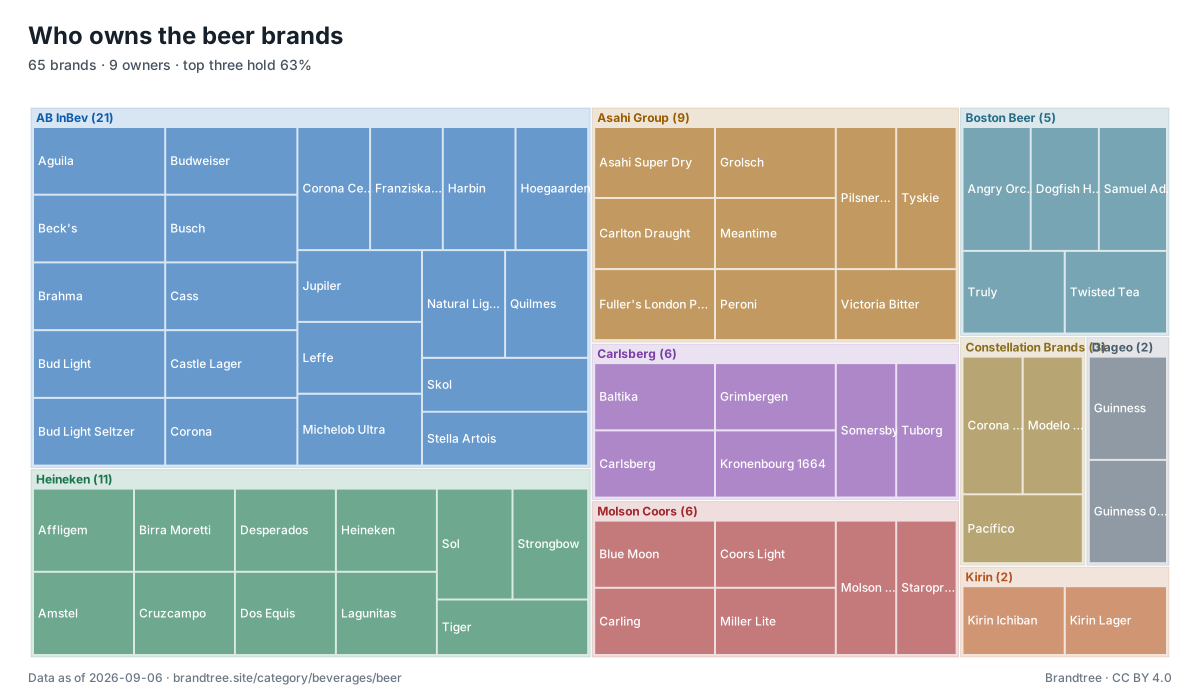
Most brands change hands because someone wanted to buy them. A smaller and more interesting group changes hands because a regulator refused to allow a merger unless somebody else was given them.
These forced sales, called remedy divestitures, are the single largest source of the confusing cases in brand ownership. They explain why a brand can have one owner in the United States and another everywhere else, and why mid-sized companies occasionally acquire household names that would never otherwise have been for sale.
The mechanism
When a merger would give the combined company too much of a market, a competition authority has three options. It can sue to block the deal outright, which is slow and uncertain. It can wave the deal through, which it will not do. Or it can approve the deal on condition that specific assets are sold to a buyer capable of competing with the merged firm.
Regulators generally prefer the third route, and prefer structural remedies over behavioural ones. Selling a brand to a competitor is self-executing: once done, no further supervision is needed. A promise to behave well requires someone to watch for years.
The condition that makes a structural remedy work is buyer viability. It is not enough to sell a name. The buyer needs everything required to compete: the trademark, the production capacity, the distribution, and independence from the seller. Regulators that have accepted weaker packages have watched divested brands wither, which is why remedy packages have grown more complete over time.
Corona: the clearest case in consumer goods
In 2013, AB InBev, already the largest brewer in the world, moved to acquire the half of Grupo Modelo it did not own. Modelo brewed Corona, Modelo Especial and Pacífico, and Corona was the best-selling imported beer in the United States.
The Department of Justice sued to block it, arguing that the deal would eliminate a vigorous competitor and lead to higher beer prices for American consumers.[1]
The settlement is what makes this case instructive. Rather than abandoning the transaction, AB InBev agreed to sell Constellation Brands the perpetual, exclusive rights to Corona, Modelo Especial and Pacífico in the United States, together with the Piedras Negras brewery in Mexico.[1] The brewery mattered as much as the brands: without it, Constellation would have depended on AB InBev for supply, and a competitor that depends on you for its product is not much of a competitor.
The result is a genuine ownership split that has now lasted more than a decade. AB InBev owns Corona in every country on earth except the United States. Constellation Brands owns it in the United States, permanently, and it has become one of the most valuable beer franchises in the country. Both statements are true simultaneously, and any answer to "who owns Corona" that gives a single company is wrong somewhere.
Miller: a divestiture inside a bigger divestiture
When AB InBev acquired SABMiller in 2016 in a deal valued at about £79 billion, regulators on several continents required divestitures.[2] The American piece went to Molson Coors, which bought SABMiller's 58% of the MillerCoors joint venture and the worldwide Miller brand portfolio.
Molson Coors had been a junior partner in a joint venture it did not control. It emerged owning Miller Lite outright, in a transaction it could never have negotiated on the open market, because the seller was not selling by choice.
Europe: commitments as the price of speed
The European Commission works the same way but with different vocabulary. A Phase I clearance under Article 6(1)(b) can be granted with conditions and obligations, which lets a deal close quickly in exchange for commitments.
Unilever's acquisition of Bestfoods, announced in June 2000, is an example. The Commission cleared it on 28 September 2000 under Article 6(1)(b) with conditions and obligations, after the parties offered divestitures in overlapping food categories.[3] Unilever got Knorr and Hellmann's, which it still owns, and gave up overlapping businesses in specific member states. Earlier that year the same Commission had cleared Unilever's purchase of the French condiments group Amora-Maille on the same basis.[4]
Both cases were resolved in Phase I. That is the trade: offer enough at the start and you avoid a Phase II investigation lasting 90 further working days, with an uncertain outcome at the end of it.
Why this matters for anyone tracing ownership
Remedy divestitures break three assumptions people bring to brand ownership.
One brand, one owner. Corona has two owners, permanently, split by territory. So do Persil, Häagen-Dazs, Pepsodent and several cereals. None of these is an error, and none will be resolved.
Brands move for commercial reasons. Some move because a court-approved settlement said they must. The buyer's strategic logic is not the explanation; the seller's need for clearance is.
Regulatory filings are only about the deal. A consent decree or an Article 6(1)(b) decision is often the only authoritative public record of exactly which brands moved, on what date, to whom, and with what production assets attached. For territorial splits it is usually the only source that establishes the boundary precisely.
This is why merger-control decisions are treated here as primary sources ranking above company statements. When AB InBev and Constellation Brands describe the Corona arrangement, they are describing something the Department of Justice defined.
[1] United States v. Anheuser-Busch InBev SA/NV and Grupo Modelo S.A.B. de C.V., proposed final judgment, US District Court for the District of Columbia, 19 April 2013. ↩
[2] Anheuser-Busch InBev SA/NV, Annual Report on Form 20-F. ↩
[3] European Commission merger case M.1990, Unilever / Bestfoods, Article 6(1)(b) decision with conditions and obligations, 28 September 2000. ↩
[4] European Commission merger case M.1802, Unilever / Amora-Maille, Article 6(1)(b) decision with conditions and obligations, 8 March 2000. ↩