The ice cream aisle just changed owners, and almost nobody noticed
In December 2025 Unilever demerged the largest ice cream business in the world. Ben & Jerry's, Magnum, Breyers and Wall's now belong to a separately listed company, and most published answers are still wrong.
Published · 1,210 words · 4 sources
Ask who owns Ben & Jerry's and almost every answer you will find says Unilever. That was true for twenty-five years. It stopped being true on 8 December 2025.
On that day The Magnum Ice Cream Company was admitted to trading on Euronext Amsterdam, the London Stock Exchange and the New York Stock Exchange, carrying with it Ben & Jerry's, Magnum, Wall's, Cornetto, Breyers, Talenti, Yasso, Popsicle, Klondike and the rest of what had been Unilever's ice cream division.[1] Unilever kept 19.9% of the new company and nothing else.[1] The business generated €7.9 billion of revenue in 2025 across roughly 80 markets, with 16,500 employees and 30 factories.[1]
This is what makes brand ownership genuinely hard to report. Nothing about the products changed. The tubs look the same, the factories are the same, the recipes are the same. What changed is who the profits belong to, and that is invisible from the freezer aisle.
How the separation actually worked
The demerger happened in two stages, and conflating them produces the wrong date.
First came the legal separation. Through 2025, Unilever moved the entities, assets and intellectual property that made up the ice cream business into a distinct corporate structure. That work was substantially completed on 1 July 2025.[1] At this point the business was ring-fenced but still Unilever's.
Then came the demerger itself. Unilever's board declared a dividend in specie: rather than paying cash, it transferred the new group to a holding company and issued that company's shares to Unilever shareholders in proportion to what they already held.[1] On 8 December 2025 those shares started trading. That is the date ownership of the brands passed to a separately listed company, and it is the date recorded here.
The retained stake matters too. Unilever group companies held 121,877,281 shares at admission, 19.9% of the issued share capital, and Unilever has indicated it will exercise votes on that holding in line with independent shareholders.[1] Nineteen point nine per cent is not control. Unilever does not own Ben & Jerry's, and no reasonable reading of the filings supports saying that it does.
What Unilever bought in 2000, and what it agreed to
The 2000 acquisition is worth revisiting, because the terms were unusual and they explain why Ben & Jerry's kept behaving differently from its owner for a quarter of a century.
Unilever did not buy Ben & Jerry's directly. Its subsidiary Conopco, Inc., a New York corporation indirectly 75% owned by Unilever N.V., formed a vehicle called Vermont All Natural Expansion Company and used it to run a cash tender offer at $43.60 per share.[3] The offer opened on 18 April 2000, expired at midnight on 15 May, and bought 6,621,944 shares, about 91% of the company.[4] A back-end merger took the rest at the same price, and Ben & Jerry's Homemade deregistered its shares on 3 August 2000.
The merger agreement, dated 11 April 2000 and amended on 5 July, did something unusual: it preserved an independent board with a continuing social mission mandate, and committed Conopco to fund a Social Venture Fund with $5 million to finance vendors owned by women, minorities and indigenous people, alongside undertakings not to make material headcount reductions for two years and to maintain employee benefits for five.[4]
Those provisions are why Ben & Jerry's spent the following two decades issuing political statements that its parent visibly did not choose, and why disputes between the brand's independent board and Unilever ended up in court rather than being settled by ordinary corporate hierarchy. The governance oddity was written into the deal.
Who else is in the freezer
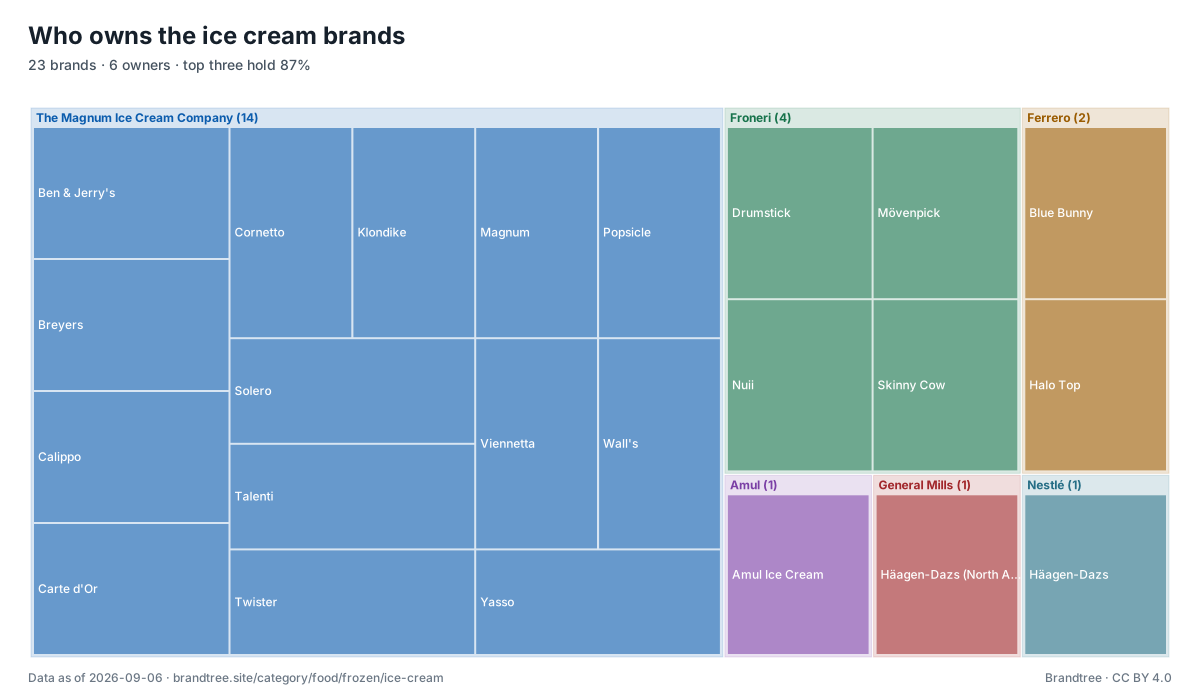
The demerger did not consolidate ice cream; it split the category further. Four owners now control the brands tracked here.
The Magnum Ice Cream Company holds the largest portfolio: Magnum, Ben & Jerry's, Wall's, Cornetto, Breyers, Talenti, Yasso, Popsicle, Klondike, Twister, Viennetta, Carte d'Or, Solero and Calippo. Wall's is worth a note of its own, because it is not really one brand: the same heart-shaped logo trades as Algida in Italy, Langnese in Germany, Frigo in Spain, Ola in the Netherlands, Kibon in Brazil, Selecta in the Philippines and Streets in Australia. Buying local ice cream companies and keeping their names while standardising the logo was the strategy for decades.
Ferrero holds Blue Bunny and Halo Top, acquired with Wells Enterprises in 2022, which took the Italian confectioner from chocolate into American frozen desserts.
Häagen-Dazs is the messiest case and the best illustration of why a single-parent answer fails. General Mills owns it in the United States and Canada, acquired with Pillsbury from Diageo in 2001. Outside North America it is operated by Froneri, the joint venture in which Nestlé holds a stake. The brand itself is American, invented in the Bronx in 1960 by Reuben Mattus, who made up a Danish-sounding name because he thought it signalled quality. There is no single correct answer to who owns Häagen-Dazs; there is an answer per territory.
Why this keeps happening
Consumer conglomerates assembled themselves for most of the twentieth century on the theory that scale in distribution and marketing beat focus. Since roughly 2015 the theory has reversed, and the largest groups have been breaking themselves up.
Kellogg split into Kellanova and WK Kellogg Co in 2023, which is why the North American rights to Corn Flakes and the international rights now sit in different listed companies. Johnson & Johnson separated its consumer health brands as Kenvue in the same year, which is why Tylenol, Band-Aid, Listerine and Neutrogena are no longer Johnson & Johnson brands. Unilever's ice cream demerger is the same move.
Each separation creates a cohort of brands whose published ownership becomes wrong overnight, and the correction takes years to propagate through search results, reference sites and general knowledge. That lag is the reason this site stores ownership with dates rather than as a single parent field: both facts are true, of different periods, and a useful answer has to say which.
What to check before you repeat an answer
If you need to know who owns a consumer brand, three questions catch most of the errors.
Has the parent spun anything off recently? Any separation completed in the last three years will still be reported wrongly in most sources.
Is the answer territorial? Corona, Persil, Häagen-Dazs, KitKat, Cadbury, Budweiser and Pepsodent all have different owners in different countries, and none of the disagreements is a mistake.
Is it ownership or a licence? Hershey makes and sells KitKat and Cadbury in the United States, but Nestlé and Mondelēz own those brands. A licensee is not an owner, and treating one as the other produces a large share of the wrong answers in circulation.
[1] The Magnum Ice Cream Company N.V., Annual Report on Form 20-F for 2025, filed 18 March 2026. ↩
[2] Unilever PLC, Annual Report on Form 20-F for 2025, filed 12 March 2026. ↩
[3] Ben & Jerry's Homemade, Inc., Form 8-K, Item 1, Changes in Control of Registrant, filed 22 May 2000. ↩
[4] Ben & Jerry's Homemade, Inc., definitive merger proxy statement on Schedule 14A, filed 6 July 2000. ↩