The great unbundling: why the biggest consumer companies are breaking themselves up
For a century consumer groups grew by absorbing brands. Since 2023, Kellogg, Johnson & Johnson and Unilever have each split in two, and the ownership records almost everyone relies on have not caught up.
Published · 829 words · 5 sources
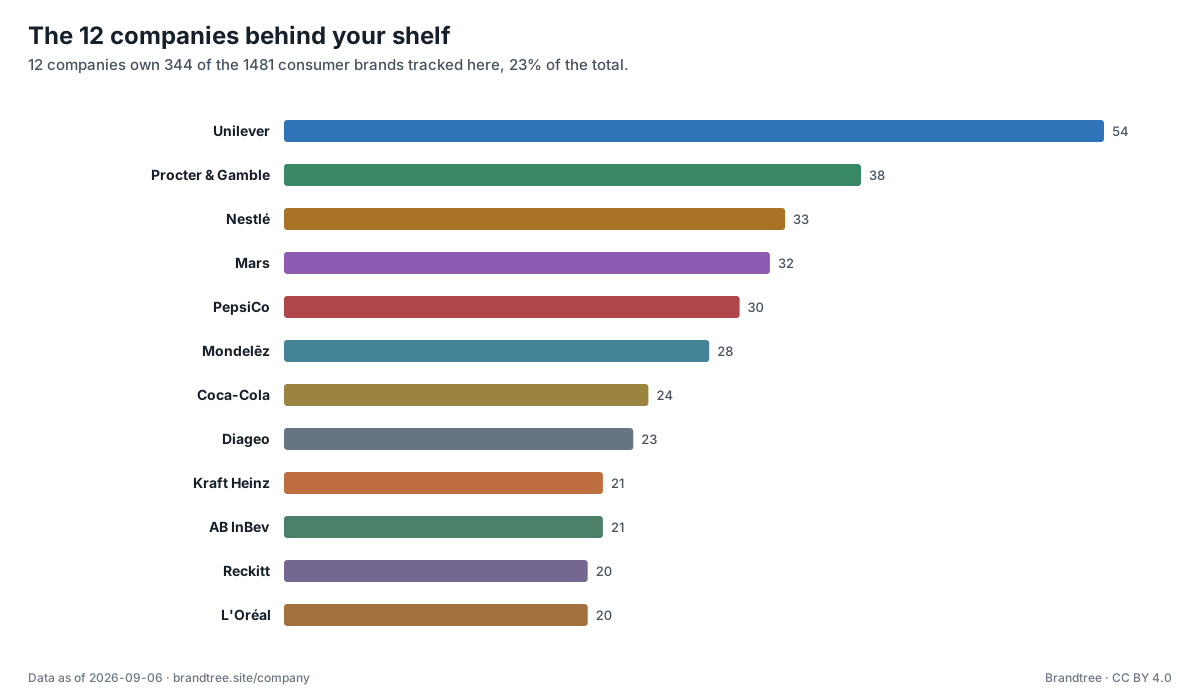
Three of the largest consumer companies in the world split themselves in two within twenty-six months of each other. Each split moved household brands to a company that did not exist before, and each one made a large body of published information wrong.
What happened, in order
Kellogg, October 2023. The Kellogg Company divided into Kellanova, which kept Pringles and the international snack and cereal business, and WK Kellogg Co, which took the North American cereal brands and the original Battle Creek headquarters.[2] Corn Flakes, Frosted Flakes, Rice Krispies, Raisin Bran and Froot Loops now have one owner in North America and another everywhere else.
Johnson & Johnson, August 2023. Johnson & Johnson separated its consumer health business as Kenvue, listing it in May and completing the split-off through an exchange offer on 23 August.[1] Tylenol, Band-Aid, Listerine, Neutrogena, Aveeno, Nicorette and Johnson's Baby all moved. The company whose name is on the baby powder no longer owns the baby powder.
Unilever, December 2025. Unilever demerged its ice cream business as The Magnum Ice Cream Company, listed on three exchanges on 8 December 2025, retaining 19.9%.[4] Ben & Jerry's, Magnum, Breyers, Wall's, Cornetto, Talenti and Yasso went with it.
Each separation was announced well in advance and executed cleanly. Each one is nonetheless still reported wrongly in a large share of the places people look.
The logic that reversed
Conglomerates assembled themselves on a reasonable premise. Shelf space is won by scale. A company with a hundred brands negotiates better with retailers, spreads advertising and distribution costs across more revenue, and can move a failing product's shelf allocation to a winning one. Procter & Gamble, Unilever and Kraft spent decades executing this.
Three things broke it.
Retailer scale caught up. When a handful of chains control most grocery distribution in a country, having a hundred brands stops being decisive leverage against a buyer who can delist any of them.
Marketing costs fell for challengers. Building a brand once required national television. Distribution and advertising through platforms let small brands reach exactly the consumers who want them, and hundreds of them took share at the edges of every category at once.
Investors began paying for focus. A company containing both a fast-growing skin care business and a slow-growing margarine business tends to be valued as though it were all margarine. Separating the two lets each be priced on its own trajectory. This is the argument every one of these splits made to its shareholders, and in each case the market accepted it.
Splitting is not the end of the story
The freshly separated companies are immediately attractive targets, because a focused business is easier to value and easier to integrate.
Mars agreed to acquire Kellanova in August 2024 for $83.50 per share in cash, valuing it at about $36 billion.[2] Ferrero agreed to acquire WK Kellogg Co in July 2025 at $23 per share.[3] Both halves of the Kellogg Company are therefore on their way to different private, family-controlled European owners, less than two years after the split that created them.
Kimberly-Clark agreed to acquire Kenvue in November 2025.[1] If it completes, Huggies and Kleenex will sit alongside Tylenol and Listerine in one company, two and a half years after Johnson & Johnson decided those brands did not belong together.
None of these announced transactions has closed, and this site records them as announced rather than creating ownership relationships for them. A deal that has been agreed is not a deal that has happened, and treating the two the same is a reliable way to publish something false.
What this does to the public record
A brand separation makes a fact wrong without making it look wrong. Nothing about the product changes. There is no recall, no relaunch, no new packaging. The only thing that changes is a line in a share register.
The result is a systematic lag. Reference sites, articles, retailer databases and general knowledge all continue to say Unilever owns Ben & Jerry's, Johnson & Johnson owns Tylenol, and Kellogg owns Corn Flakes. Every one of those statements was true recently and none is true now.
Three habits fix most of it. Store ownership with dates, so both the old and the new answer survive and the question becomes "as of when". Cite a filing rather than a company statement, because a Form 10-K states plainly what a corporate website leaves vague. And check whether an announced deal has actually closed before recording it as ownership.
The alternative is what currently exists: a large body of confidently stated brand ownership information that quietly went out of date and never got corrected.
[1] Kenvue Inc., Annual Report on Form 10-K. ↩
[2] Kellanova, Annual Report. ↩
[3] WK Kellogg Co, Annual Report. ↩
[4] The Magnum Ice Cream Company N.V., Annual Report on Form 20-F for 2025, filed 18 March 2026. ↩